From Chats to Control: How Tech Is Being Weaponised Against Women and Girls
Technology can be a lifeline for survivors of domestic violence, sexual violence, and stalking, helping them access information, connect with support, and stay safe. Yet it is also too often misused by abusers to harass, threaten, monitor, exploit, and violate. The rise of smartphones, social media, and digital communication means that abuse can follow survivors everywhere, through screens, passwords, and posts.
Online abuse includes a wide range of tactics, from sharing humiliating or false content and impersonation to doxing (revealing identifying information about someone online), stalking, electronic surveillance, and the non-consensual use of intimate images. Increasingly, abusers also weaponize artificial intelligence to create fabricated sexual images or videos designed to humiliate and destroy. Online harassment is intersectional, frequently entwined with sexism, racism, homophobia, and other forms of oppression.
For survivors like Lindiwe, whose ex-partner shared her private photos online, each notification can feel like another violation, a reminder that the abuse has followed her home. Technology connects us in extraordinary ways, but for many, it has also opened new pathways for harm. Across the world, and increasingly in South Africa, gender-based violence is being carried out through screens and smartphones, blurring the line between digital and physical safety.
Technology-facilitated gender-based violence (TF-GBV) refers to acts of abuse, harassment, control, or exploitation committed through digital tools. It includes non-consensual sharing of intimate images, online stalking or surveillance, impersonation, blackmail, and gendered hate speech. Though it happens online, the harm it inflicts is deeply real. Like all forms of GBV, TF-GBV is about power, not technology.
The impact on survivors is profound. Digital abuse leads to fear, anxiety, and humiliation, leaving scars that do not fade with time. Survivors may withdraw from school, work, or social spaces to escape harassment. A 2023 UN Women study found that 58% of women have experienced online harassment or abuse, with many fearing it could escalate offline. In South Africa, where internet access is expanding faster than digital protections, online violence deepens existing vulnerabilities such as poverty, stigma, and limited access to justice.
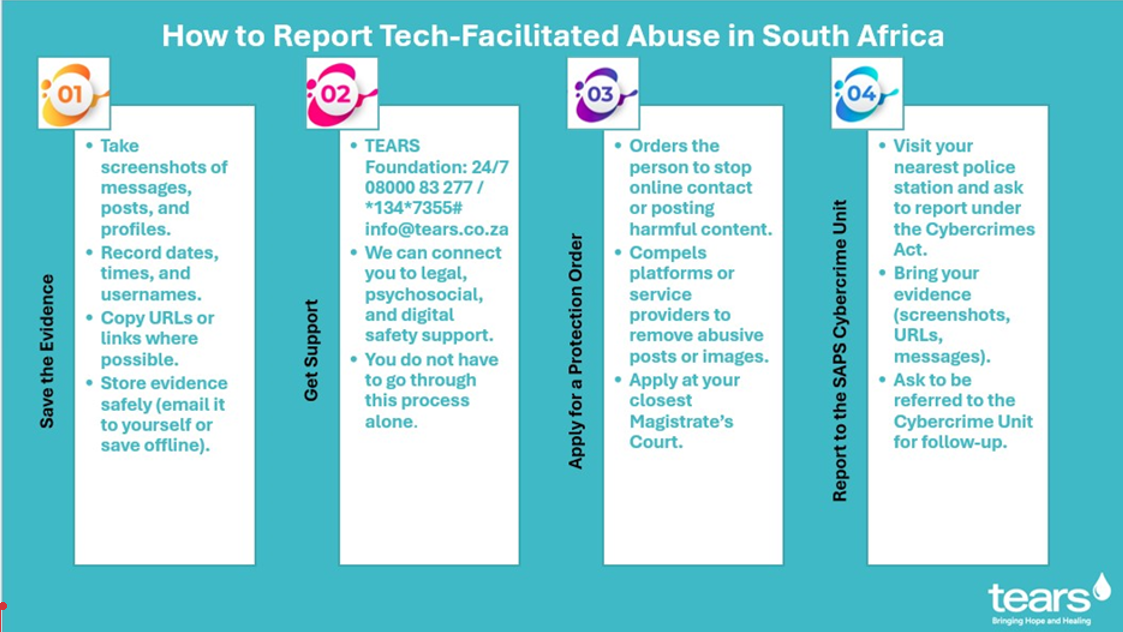
Reporting digital abuse can be daunting. Many survivors do not know where to start, and police are not always equipped to respond effectively. Evidence can be deleted, perpetrators hide behind fake accounts, and victims are too often dismissed or blamed. Yet South African law does make provision for protection. Under the Domestic Violence Act and the Protection from Harassment Act, survivors of cyber-abuse can apply for a protection order. This can compel perpetrators to stop contacting or posting about survivors online, and may require digital platforms or service providers to remove harmful content.
Filing a cybercrime complaint through the SAPS Cybercrime Unit is also possible, though navigating the process can be complex. Survivors are often expected to collect screenshots, message histories, and URLs themselves to prove a pattern of harassment. These laws are still new, and enforcement remains inconsistent due to limited resources and training within the system. Reporting is rarely easy, but it is a crucial step in reclaiming safety and dignity.
Ending TF-GBV begins with awareness, empathy, and action. Believing survivors is the first step. Listening without judgment and validating their experiences can mean the difference between silence and healing. Survivors should be encouraged to document safely, taking screenshots, noting dates, and storing evidence securely, and to reach out to services that understand both the emotional and legal complexities of digital abuse.
Each of us has a role in making digital spaces safer. We can model respect and consent online, speak out against digital shaming, and teach young people about empathy and boundaries in the virtual world.
If our goal is to reclaim technology as a tool for connection and empowerment — not a weapon for control and abuse — we must believe survivors, strengthen digital safety, and hold perpetrators accountable.
In doing so, we affirm a simple truth: safety is not only physical — it is digital, emotional, and deeply human. Our online world can only be as safe as we make it.
Together, we can build a future where technology is used to connect and empower, never to harm.
If you have suffered at the hands of cybercrime, we are one call away – simply dial 08000 83 277 for free, confidential assistance 24/7.